
We’re All Just Humans. Even Your Buyers.
.png)
It’s hard to pinpoint, but about five years ago—sometime before a certain nasty pandemic rattled our work world—marketers broadly began to acknowledge the validity of B2H (business-to-human) practices as a necessary evolution from the decades-old beliefs of B2B marketing.
What caused this shift isn’t that important. It was probably some combination of younger generations achieving corporate leadership positions or elevated buyer expectations driven by hypnotic B2C brand experiences. More likely, it was driven by the fact that prospective buyers finally reached a breaking point with the absurd volume of B2B messaging being fire-hosed at them every day.
But while the B2B world agreed that B2H provided a better way forward, most remained faithful to the old ways—relying on product features, tech specs and claims of “world leadership” and “seamless integration” to woo prospective buyers. And no matter how much was spent on marketing automation, PPC, SEO and digital ad placements, the results just kept slipping. Even if top-of-funnel wasn’t a problem, the desired volume of closed deals remained elusive.
Then came the overcorrection. Too many newly minted B2H marketers ditched all of that slightly boring—but entirely necessary—B2B marketing information in favor of humor, folksy social posts or websites and ebooks packed with human interest stories.
As we move into 2026, we’re starting to see more B2B brands—including many of our clients—mastering the art and science of B2H marketing. It’s encouraging. It’s also professionally and financially rewarding for our clients.
So, what’s the secret? How does a B2B practitioner make the transition to B2H? What is the thinking behind B2H?
Here are some initial thoughts:
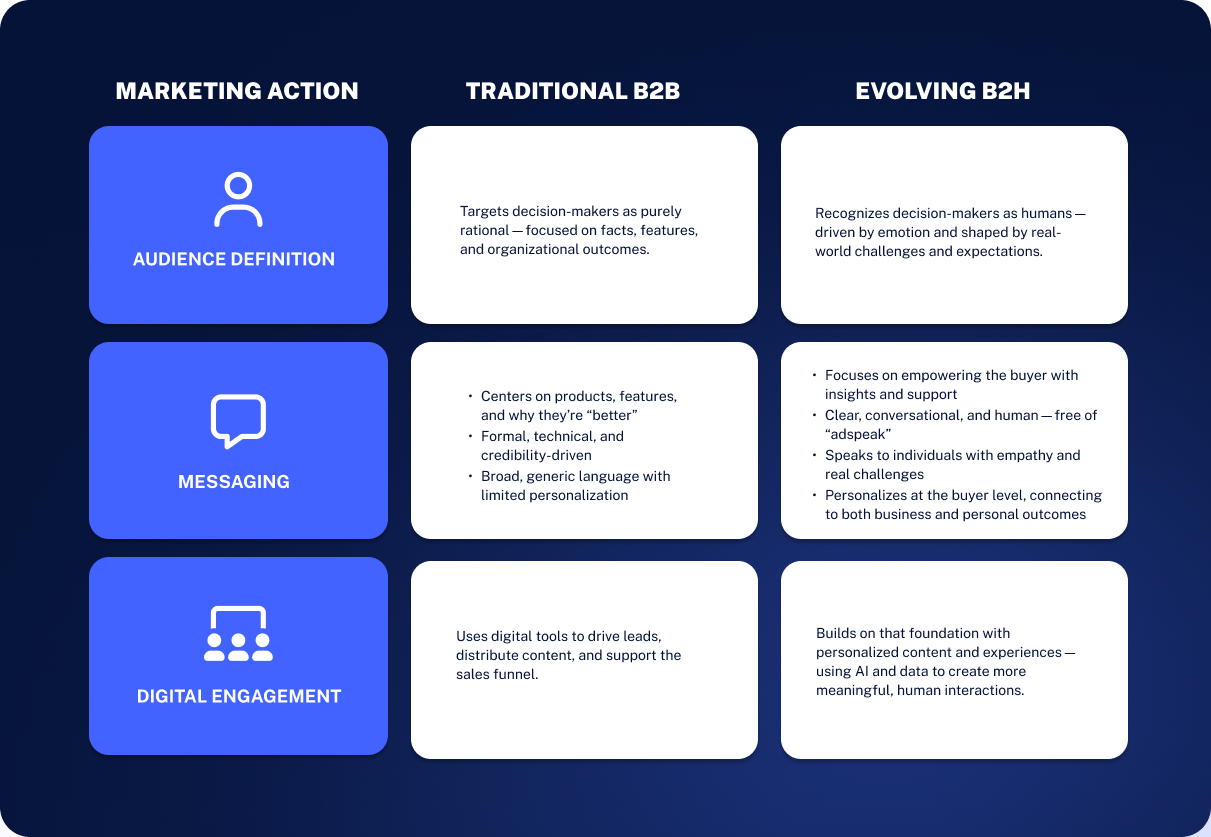
It’s important to understand—at least at a cursory level—the human factors behind the decision to buy a particular offering and then remain increasingly loyal to a brand and the company behind it. Viewing messaging, positioning and the selling process in the context of these realities is a great first step towards successful B2H marketing.
Risk Aversion: This is relatable to everyone. We deal with it every day as consumers. Making the wrong buying decision, at a minimum, leads to wasted time and money. More seriously, it could cause damage to the enterprise or an individual career.
Professional Status: Whether it’s from the people they report to, the people they manage or peers in other organizations, buyers want the decisions they make to contribute to their reputations as accomplished professionals
Feeling of Trust: Buyers seek the comfort of certainty. This can’t be generated in a vacuum, so buyers look to explore reviews, seek peer advice and look for credible evidence that the company they ultimately buy from is smart, reputable and stable.
Personal Connection: Buyers may get 80% of the way to a purchase, but salespeople and field teams are still critical in driving initial and sustained buying behaviors. Buyers get a sense of connection from people, not organizations.
.png)