
The tactics are tired. The fundamentals never left. Here's where B2B marketing goes next.

The Rolling Stones have played roughly the same set for fifty years. They’re still selling out stadiums.
U2 has been topping charts and selling out shows for 40+ years, but their sound has constantly changed: Joshua Tree doesn't sound like Pop or Songs of Innocence — and they’ve continued to innovate for shows like their opening of the Sphere in Las Vegas.
T-Swift has jumped across entire genres — from country to pop, then stripped-down folk and more recently the spectacle of the Eras Tour.
Three different bets. All of them worked. So what’s this got to do with B2B marketing?
Most B2B marketing looks like the Rolling Stones right now, still running the 2015 setlist: gated ebooks, MQL-to-SQL scoring, a blog built to feed an algorithm instead of a person. But ebooks lack the magnetic charisma of Mick Jagger, and a two-year-old blog somehow looks so much rougher than Keith Richards after 60+ years of…being Keith Richards. Yet marketers keep on rinsing and repeating because they used to work, and because changing the show is scarier than an empty room.
Here is the case for a new setlist and an innovate experience, built on the fundamentals that never actually left.
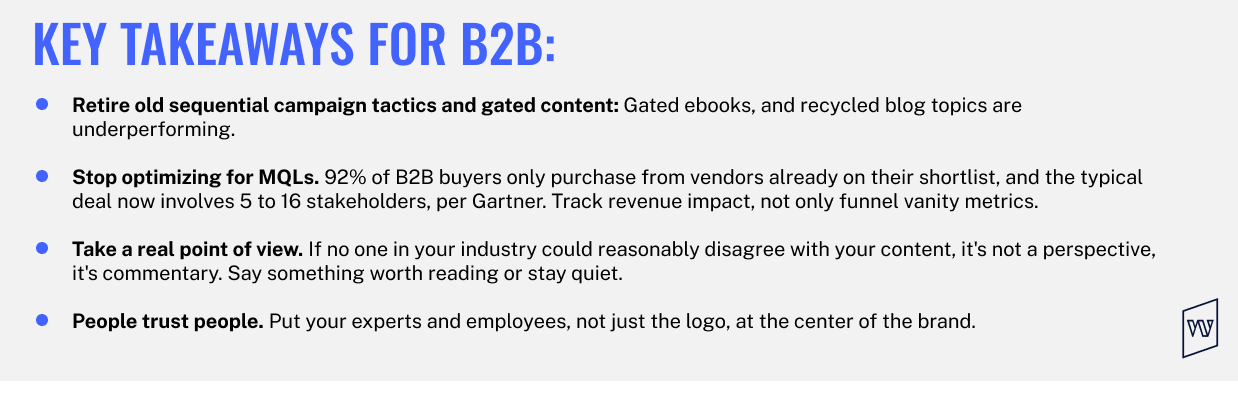
Talk with most B2B marketing teams and you'll find the same old campaign machine humming in the background. A dedicated landing page for every campaign, most getting less traffic and conversions than the product page it duplicates. A gated ebook that doesn’t really say anything of value and that nobody wants to trade an email for. A weekly blog post written on the same topic as one you did two months (or two years) ago.
Who decided that just because someone downloaded a random eBook or registered for a webinar that they are ready to buy? Our reliance on and practice of fast follow-up and BDRs have made it less and less likely that anyone will actually download the generic content (that is metastasizing thanks to AI).
Meanwhile, tool sprawl keeps growing and marketing teams keep getting more bloated with platforms, acronyms, and job titles nobody had five years ago. The fundamentals — actually understanding your buyer and building something they need and addresses real challenges — get less attention every year

Instead, brands need to focus on original research and insights that buyers can’t get from anyone else to build trust and influence their decision making.
.png)
If your 2027 plan reads like your 2019 plan with campaigns and gated content or drip campaigns all with some AI sprinkled in, it might be time for an upgrade.
Marketing has spent 15 years chasing a growing list of three-letter goals: MQLs, SALs, SQLs, ABM, CPM, CTR, TMS (only one is made up). Every one is based on a funnel with clean stages and a dashboard that makes buying look like a straight line.
Buying isn’t a straight line. A B2B buyer bumps into your brand a dozen different ways before they ever fill out a form: a colleague's recommendation, a conference hallway conversation, a LinkedIn post they half-read before 8am. Most of that won’t show up in attribution software. Chase one of those three-letter goals and you can might be able to optimize for the small slice of the journey you can see. But you’ll miss the rest of what actually decides the deal (and in a few years, a new CMO will come in promising that a different three-letter goal is the real holy grail).
Then there’s the reality that the typical B2B buying decision can have anyone from five to 16 people involved, according to Gartner.
.png)
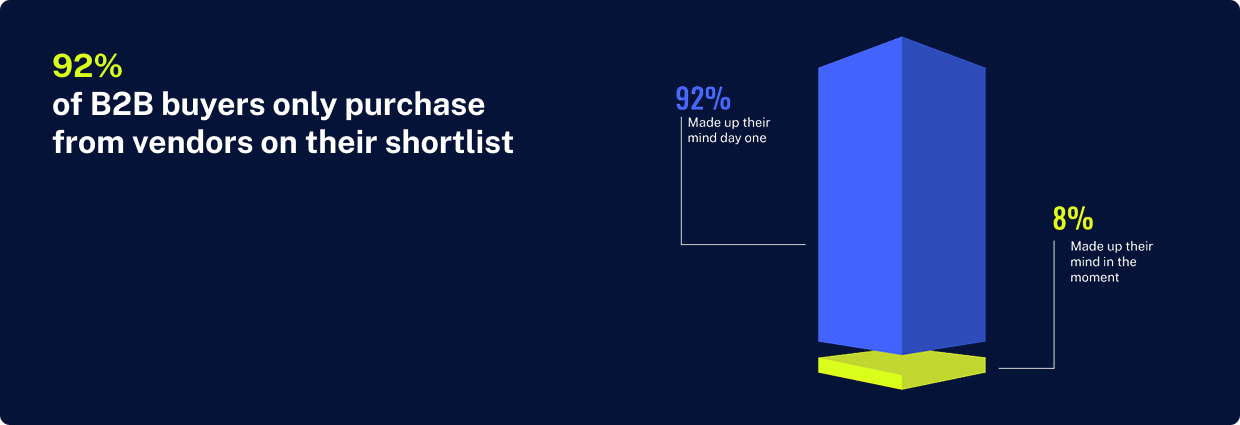
Here’s another gut punch: 92% of B2B buyers only purchase from the vendors already on their day-one shortlist, the brands they knew before they started actively researching. That means “the funnel” is often only the last few minutes of a decision-making process that your brand already won or lost months earlier.
The CMOs winning boardroom arguments right now aren't the ones with the cleanest MQL dashboard. They're the ones who can explain how the brand is impacting revenue and pipeline, and who've built a real relationship with their Finance and Sales teams instead of dodging their questions.
Stop gating everything you make. Give the insight away. Measure intent by what people tell you on your own form when they're ready, not by how many PDFs they downloaded or events they registered for but didn’t attend.
Remember when you were a kid and adults told you, “If you don’t have anything nice to say, don’t say anything at all.”? Here’s the B2B version: If you don’t have anything interesting to say, you’re better off saying nothing at all.
.png)
As marketing strategies target top-of-funnel awareness and content plans chase algorithmic favor, we’ve all heard (and maybe said) things about “being part of the conversation” or “holding mindshare.” Yes, the ideal would be to captivate audiences with daily wisdom. But the reality is that the vast majority of content couldn’t possibly be called wisdom. At best, it’s recycled consensus. At worst, it’s 673 words of AI slop that leaves a reader frustrated (at your brand…at the world…).
Social media platforms have shown just how valuable every second of attention really is. So, if you’re going to ask your audience for a few of their seconds, make sure you really have something interesting to say. Publish less. Say more when you do.
We mentioned original research as one way to share truly novel information. The other is to offer up a unique point of view.
Here’s one way to test whether something qualifies as an interesting point of view: could someone in your industry read it and meaningfully disagree? If the honest answer is no, then you’re likely not giving original perspective, thought leadership, or a real ‘hot take.’
.png)
In a lot of cases, the key is dropping the hedge and soft language. Say the bold thing. Let your sales teams or experts handle the exceptions in the room, where nuance actually belongs. A point of view that never risks being wrong was never really a point of view.
Part of the dearth of interesting B2B perspectives is that, somewhere in the last decade, most brands got scared to lose or offend anyone. Every message got softened until it kind of worked for everybody and excited nobody. AI is comically adept at producing this kind of polished-yet-empty content in seconds.
But whether you call it a target market, an ICP, or some other marketing buzzword, the reality is your brand isn’t for everyone. That’s the point.
.png)
Luxury fashion already ran this experiment for us. Between roughly 2018 and 2020, Burberry, Balenciaga, Saint Laurent, and half the rest of the industry all landed on the same stripped-down sans-serif logo. It made every house harder to tell apart, and it didn't work.
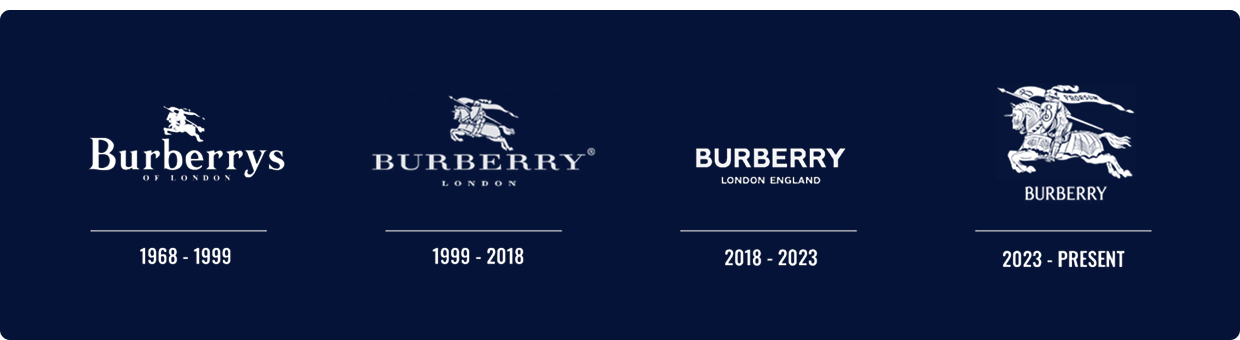
Burberry reversed course in 2023, bringing back its 122-year-old Equestrian Knight and a serif wordmark. The rest of the category followed, in what's now being called the shift from “blanding” to “granding.”
We’ve talked a lot about what you say, but being interesting is just as much about how you look. Brand design is a decision about whether you're willing to be memorable or just play it safe.
.png)
Trust is growing more scarce and moving local. The 2026 Edelman Trust Barometer found people narrowing their circles down to what's familiar: friends, neighbors, colleagues. Across every institution measured, the one people trust most is “my employer.” More than government, media, or business in general.
.png)
That's a gift most B2B brands aren’t using: Your employees are your most credible advocates.
.png)
The company website or LinkedIn page is where trust gets directed to action. But that trust increasingly starts with a person. Brands need to be using their website and LinkedIn pages as the stage to spotlight their people and spark these human connections.
The Rolling Stones aren't wrong to play the hits. Fifty years of sold-out stadiums is impossible to argue with. But the Stones stuck with that strategy because it never faltered. Many B2B marketing teams didn't choose that path on purpose. They just stopped writing new songs.
The tactics should keep changing. What worked in 2015 or 2021 doesn't work now, and whatever's working right now won't work in five years, either. That's fine. That's how it's supposed to go. What shouldn't move are the fundamentals underneath: Build a brand people already trust before they're in market. Say something interesting instead of restating consensus. Earn trust through your people, not your logo. Have the nerve to be different, in what you say and in how you look.
Buyers are people, and people want to hear from other people.
Follow us on LinkedIn to get more insights on how you can build marketing strategies that actually deliver results (not just more three-letter marketing metrics).
.png)